France’s Fast Fashion Law
One of Earth’s Biggest Pollutants
Climate change’s impact on the Earth is becoming evermore prominent year after year. According to the United Nations environment program, the Earth is projected to reach a temperature of 1.5C. The ramifications of the rise in temperature will cause climate crises to push climate risks to increasingly dangerous heights. The climate crisis is a result of various industries that produce pollutants, one of the biggest of these contributors, the fast fashion industry. France’s latest law is setting a precedent for the future of sustainability, fashion, and how businesses manufacture and promote their products. The law aims to restrict and limit the prominence of fast fashion companies in the French market.
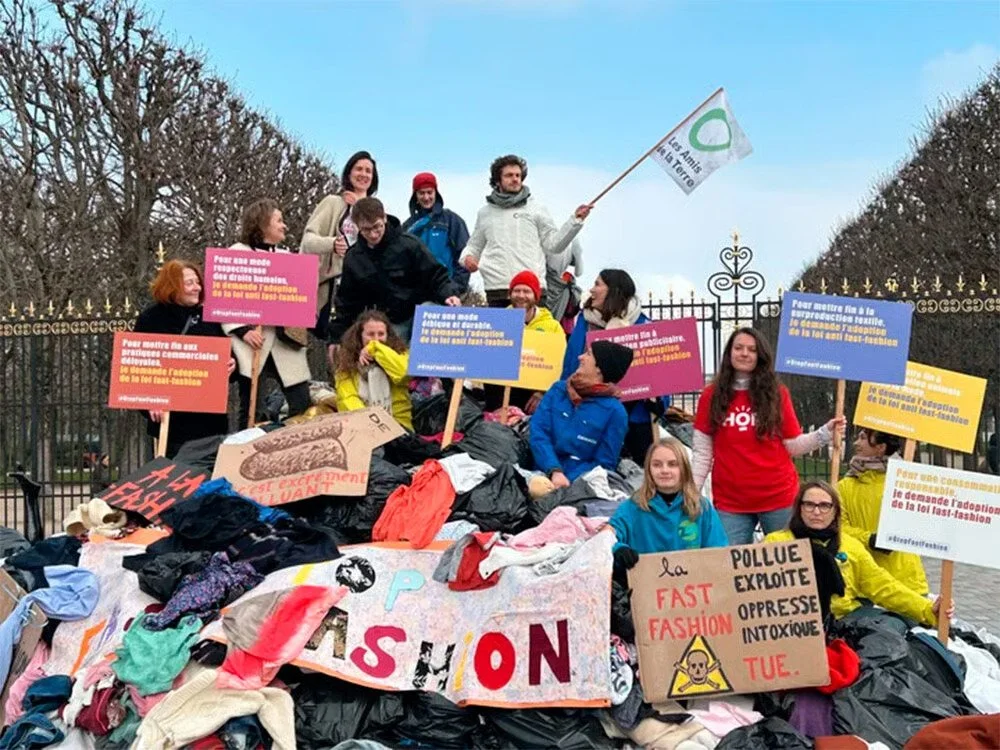
French protestors advocating for new law. (Fast Network)
What does France consider fast fashion?
To understand the scope of this law, one must first understand what France defines as “fast fashion”. The French Environmental Code defines “ultra-fast fashion” as industrial or commercial practices that place a large volume of new clothing, footwear, or home wear textiles on the market, while providing little incentive to repair them. Goods must meet both conditions to be considered fast fashion (Library of Congress). This law aims to target large fashion brands that manufacture goods through processes that actively harm and pollute the environment.
This new law also covers large online retailers such as Shein and Temu. Any platform that facilitates the purchase or rapid delivery of fashion items are covered. These platforms are now required to display a message on their website that informs consumers on sustainable consumption practices. Including, social, environmental, and health impacts of these products and ways to moderate, reuse, repair, repurpose, and recycle fashion items.
What does France’s New Law Do?
The goal of this new regulation is to limit the profit, prominence, and impact fast fashion brands have. Through new consumer transparency laws, advertising bans, and new educational curriculums. In addition, these fast fashion brands are now subject to financial penalties per item sold in France.
One of the biggest implications of this new fast fashion law is the financial responsibility it places on producers and manufacturers. In France, producers of fast fashion goods make financial contributors to Refashion, an eco-organization approved by the government to coordinate textile recycling. With the addition of this law, the basis for determining the Refashion payments now include a product’s environmental impact, as well as any practices that influence the product’s lifespan and the likelihood that it will become waste. A portion of Refashion’s payments will be used to fund infrastructure for collecting, sorting, reusing, and recycling textile goods in France.
Starting on September 1st, 2026, ultra-fast fashion companies will be subject to financial penalties per item. These penalties range from 25 euro cents to 12 euros (about $0.30-$14) per product. In 2030, these penalties will increase to 2 euros to 20 euros ($2.30 - $23). In addition to these penalties, companies based abroad will now be required to appoint a representative in France to handle obligations arising under extended producer responsibility. These new financial regulations will pose a heavy burden on fast fashion retailers and may deter them entirely from selling their products in France.
The law also takes into consideration the environmental impact of fashion products. Factors such as a product's carbon footprint, durability, impact on biodiversity, and likelihood of becoming waste can influence the financial contribution associated with the product. This means that fashion companies will have greater financial incentives to consider how their products are designed, produced, and eventually disposed of.
The Fast Fashion Law also requires brands to include further transparency on manufacturing locations. All e-commerce platforms must now disclose a product’s manufacturing location to consumers in a clear and legible manner. This is to ensure that consumers know their products are being made by an ethical manufacturer that abides by proper regulations.
Another major component of the law involves advertising. Beginning January 1, 2027, ultra-fast-fashion brands will face restrictions on advertising their products. The restrictions also extend to influencer marketing, meaning influencers will no longer be able to promote products or brands that fall under the law's definition of ultra-fast fashion.
This is particularly significant because social media has become one of the most important marketing tools for fast-fashion companies. Brands such as Shein have relied heavily on social media creators, product hauls, discount codes, and viral trends to reach younger consumers. Removing one of these major marketing channels could force these companies to rethink how they communicate with their audiences.
How Could the Law Change Fashion Marketing?
France's legislation is important because it addresses the environmental consequences of fast fashion. It also challenges the marketing strategies that have helped make ultra-fast fashion so successful.
Traditional fashion marketing often focuses on creating desire around a new collection or seasonal trend. Ultra-fast fashion has taken this concept much further. New products are constantly introduced, trends can change almost overnight, and social media allows consumers to immediately see and purchase what is trending.
Influencer marketing has played an especially important role in this process. A consumer may see an influencer wearing a $10 top on TikTok or Instagram and immediately be able to purchase the same item. This creates a direct connection between marketing, entertainment, and purchasing. France's decision to restrict influencer promotion therefore targets one of the ways that ultra-fast-fashion companies create demand.
The law could force companies to reconsider how they build relationships with consumers. If brands cannot rely as heavily on traditional digital advertising or influencers, they may need to invest more in other forms of marketing, such as public relations, brand storytelling, retail experiences, customer loyalty programs, and organic social media content.
It could also change the way fashion brands approach their products. If companies face higher costs for producing large quantities of environmentally damaging products, producing fewer but higher-quality products could become more attractive.
What Does This Mean for Consumers?
One of the biggest questions surrounding the law is whether it will actually change consumer behavior.
Ultra-fast fashion has become popular largely because of its affordability. Consumers can purchase multiple pieces of clothing for the price of one item from a traditional retailer. Increasing the cost of these products could discourage some consumers from making frequent purchases.
However, the law is unlikely to eliminate the demand for inexpensive clothing completely. Even with additional fees, ultra-fast-fashion products may remain cheaper than many alternatives. Fashion industry analysts have argued that companies could respond by absorbing some of the additional costs, raising prices, or reducing their profit margins.
There is also a concern about how these costs could affect lower-income consumers. For shoppers who rely on inexpensive clothing because of financial limitations, higher prices could create an additional burden. This raises an important question: Can government regulation successfully encourage sustainable consumption without making clothing less accessible to consumers who depend on low prices?
The answer may depend on whether consumers are willing to change their purchasing habits when sustainable alternatives are more expensive.
How Could Fashion Companies Respond?
The law could encourage ultra-fast-fashion companies to change more than just their prices. Companies may begin looking for ways to reduce their environmental impact so that they can lower the financial penalties associated with their products.
For example, brands could focus on producing clothing that lasts longer, using materials with lower environmental impacts, reducing excess inventory, and improving recycling or reuse programs. These changes could ultimately influence how products are designed and manufactured.
At the same time, companies may look for new ways to maintain their relationships with consumers. If influencer advertising becomes more restricted, brands could shift toward other forms of digital engagement, including user-generated content, online communities, email marketing, and direct communication with customers.
This could create an interesting shift in fashion marketing. Instead of encouraging consumers to constantly buy something new, brands may increasingly have to explain why a product is worth buying and keeping.
That would represent a major change from the traditional fast-fashion model, where low prices and constantly changing trends encourage consumers to purchase frequently.
What Could This Mean for the Future of Fashion?
France's new law demonstrates that the fashion industry is no longer being viewed solely as a creative or retail industry. Fashion is increasingly connected to environmental policy, consumer protection, international trade, and government regulation.
The law also demonstrates how closely connected marketing and regulation have become. By restricting advertising and influencer promotion, France is targeting not only the products that companies sell but also the ways they persuade consumers to buy them.
This could have a long-term effect on the industry's definition of successful marketing. For decades, fashion marketing has often been about creating excitement around the newest trend and encouraging consumers to keep up with changing styles. France's law challenges that model by encouraging consumers and companies to think about the environmental consequences behind those purchases.
Ultimately, France's new legislation may not eliminate fast fashion. Consumers will likely continue to look for affordable and trendy clothing, and companies will continue to find creative ways to reach their audiences. However, the law could make the current ultra-fast-fashion model more expensive and more difficult to sustain.
More importantly, France has established a precedent. Other countries now have an example of what regulating ultra-fast fashion could look like. If additional governments follow France's lead, fashion companies may have to rethink everything from product design and manufacturing to pricing and marketing.
The future of fashion may therefore depend on finding a balance between affordability, consumer demand, profitability, and environmental responsibility. France's new law is an indication that governments are becoming increasingly willing to play a role in finding that balance and the fashion industry will have to adapt.